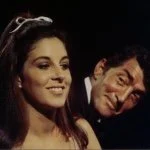
I'm proud to announce one
of my most exciting and challenging projects to date.
My memoir, "Memories Are Made of This",
is available now at a bookstore near you.
Editorial
Reviews From
Publishers Weekly
In this evenhanded biography of her famous father,
Deana Martin acknowledges that Dean "wasn't a
good father, but he was a good man." The youngest
child of four from Dean Martin's marriage to his first
wife, Betty MacDonald, the author recalls how her
mother began drinking so heavily that Dean's new wife,
Jeanne Biegger, eventually took Betty's three girls
in (Betty's son was living with his grandparents)
and brought them up along with the three children
she had with Dean. Martin details her father's life
from his teenage years as a card dealer to his first
Atlantic City gig with Jerry Lewis, offering her own
observations along the way ("A glass of apple
juice masquerading as scotch in his hand, he perfected
a role that was going to become... indistinguishable
from the real Dean Martin"). Perhaps Martin forgives
her emotionally detached father too quickly, as when
he doesn't show up at her first live theater performance
("I guess Dad felt that with so many children,
if he did it for one, he would have spent his whole
life doing it for the others"). But in the end,
hers is a heartfelt and honest portrait of a mysterious
father.
Copyright © Reed Business Information, a division
of Reed Elsevier Inc. All rights reserved.
From the Inside Flap
I loved being called Deana Martin. Even when I was
very small. Dad was such a positive influence on people’s
lives that to be so closely associated with him was
always a blessing. People can’t help but smile when
they think of my father, which has to be the greatest
legacy of all. When people hear my name for the first
time, they usually ask the same question: “Any relation?”
“Yes,” I reply proudly, “he’s my father.” They smile
and cry, “Oh, I love your father! I’ve loved him all
my life.” Sometimes, just sometimes, they ask me the
most important question of all: “Was he a good father?”
To their surprise, I shake my head and smile. “No,”
I reply. “He wasn’t a good father, but he was a good
man.” Where Dad came from, that meant a great deal
more.
So
begins Deana Martin’s captivating and heartfelt memoir
of her father, the son of an Italian immigrant from
modest beginnings who worked his way to the top of
the Hollywood firmament to become one of the greatest
stars of all time.
Charming,
debonair, and impeccably attired in a black tuxedo,
Dean Martin was coolness incarnate. His music provided
the soundtrack of romance, and his image captivated
movie and television audiences for more than fifty
years. His daughter Deana was among his most devoted
fans, but she also knew a side of him that few others
ever glimpsed.
In
page-turning prose, Deana recalls her early childhood,
when she and her siblings were left in the erratic
care of Dean’s loving but alcoholic first wife. She
chronicles the constantly changing blended family
that marked her youth, along with the unexpected moments
of silliness and tenderness that this unusual Hollywood
family shared. Deana candidly reveals the impact of
Dean’s fame and characteristic aloofness on her efforts
to forge her own identity, but delights in sharing
wonderful, never-before-told stories about her father
and his pallies known as the Rat Pack. It may not
have been a normal childhood, but Deana’s enchanting
account of life as the daughter of one of Hollywood’s
sexiest icons will leave you entertained, delighted,
and nostalgic for a time gone by.
“From
her heart, Deana Martin has told a frank and honest
account of what her life was like with her famous
father and family. It has been a wild ride, with lots
of ups and downs, written with honesty, love, and
understanding.” —Regis Philbin
“Dean
Martin was the unique star who attained success in
all of the entertainment media—movies, TV, recordings,
concerts, and radio. His daughter Deana gives us something
else that is also unique in this revealing book about
growing up as the daughter of a true legend. Here’s
to you Dean. I’ve got the booze, you get the ice.”
—Don Rickles
“I
have to say I loved reading what Deana wrote—maybe
because she bit the bullet, she was courageous, up-front,
tenacious, and so totally forthright. I read it with
tremendous pride and love, and I know other readers
will feel the same emotions I felt. I love this author
for a myriad of reasons, but especially for how she
has honored my partner.”—from the Foreword by Jerry
Lewis
About the Author
Deana Martin is an actress, entertainer, and author
living with her husband in Beverly Hills, California.
She is the director of the Deana Martin Foundation
and the producer and driving force behind the annual
Dean Martin Festival.
Excerpt. © Reprinted
by permission. All rights reserved.
Chapter One
Inside each of us is a small, dark
place we can escape to when we're in pain. It is a
silent sanctuary where comforting thoughts and memories
wash over us, providing a soothing balm for the fear
we're feeling inside. I first discovered mine when
I was quite small. Cared for by an aunt while my mother
disappeared for three days, I was sent to live with
my father, a man I barely knew despite the name I
bore.
I can vividly recall standing in the
foyer of his opulent Beverly Hills mansion, along
with three big boxes of clothes belonging to me and
my two older sisters. A woman I knew as my stepmother
picked up each item between her thumb and forefinger.
"No, not this," she'd say, or, "This
looks clean, we'll keep it," or-with a sympathetic
look-"This can go to Goodwill." One of the
boxes was mine, and
I stood staring at my only possessions
being picked over and graded.
That first interminable summer in
my father's house, I remained completely mute, breaking
my silence only occasionally to whisper my fears to
my sisters, from whom I became inseparable. My arms
were pocked with hives, my skin raw from nervous scratching.
While my father worked hard to maintain his position
in Hollywood, revered by his millions of fans, his
little Deana sat clutching the banisters every night.
Dressed in one of my stepmother's baby-doll nighties,
I dripped silent tears on the top step of his grand
staircase, grieving for a loss too enormous for a
nine-year-old child to comprehend.
On August 19, 1948, the day I was
born in the Leroy Sanatorium, New York City, my father
was busy doing what he did best. I emerged into the
world at the very same moment a desperate woman threw
herself from the window of the Russian embassy across
the street. The media throng that gathered outside
to cover the mystery suicide had no idea that Dean
Martin's fourth child was bawling for attention just
feet away.
Dad was on the other end of the country
at the time, with his comedy partner, Jerry Lewis,
playing at Slapsy Maxie's Café, a popular new
nightclub on Wilshire Boulevard in Los Angeles. Theirs
was the hottest ticket in town, and regularly filling
front-row seats were friends like Humphrey Bogart,
Tony Curtis, and Janet Leigh. Sitting alongside them
would be stars like Fred Astaire, Clark Gable, Joan
Crawford, Jane Wyman, James Cagney, and Gary Cooper,
as well as just about every studio head and entertainment
executive in town. Dad opened each show with a song.
The minute he walked out onto that stage, the atmosphere
was electric. His image, style, magnetism, class,
and talent just lit up the club. Hollywood's brightest
settled back into their seats, eagerly anticipating
what lay ahead.
Dad and Jerry were superstars, earning
around ten thousand dollars a week just after the
end of the Second World War. They were about to sign
a ten-movie, five-year deal with Paramount Studios
worth $1,250,000. They also had a separate recording
contract with Capitol Records and a radio deal with
NBC. With three young children and my recent arrival,
Dad was finally succeeding in paying off the debts
that had dogged him for years, and funding the fairy-tale
lifestyle he hoped to create for us all.
My mother, Betty, called Dad at the
Hollywood Roosevelt Hotel the night I was born to
tell him he had a new daughter to add to his family.
He was so deeply asleep when he took the call that
he thought it was someone fooling around and hung
up. Hours later, Dad rang back to see if his hazy
memory of the previous night was correct. It was true.
Mother had given him another baby girl. Between them,
they settled on the name Deana Angela. Dad had always
wanted at least some of his children to be named after
him. Having successfully chosen the names Craig, Gail,
and Claudia, Mother was only too happy to comply with
Dad's request. At the hospital, the registrar misspelled
my name, writing it as Dina on my birth certificate,
much to Mother's annoyance. It was a mistake that
was to be repeated throughout my life. When the gossip
columnist Walter Winchell wrote in his Sunday column
that my name was Dinah, my mother was exasperated.
She sang the line from the song, "Dinah? Is there
anyone finah in the state of Carolina?" and muttered,
"Can't Winchell get anything right?"
It was two months before my father
finally met me. His West Coast debut of The Martin
& Lewis Show and his first movie role with Jerry
in the film My Friend Irma kept him more than three
thousand miles from 315 West 106th Street and Riverside,
New York. That was where I shared an apartment with
my mother, brother, and sisters and our housekeeper,
Sue. Staying with us were my maternal grandmother,
Gertrude, and my young aunts Anne and Barbara, who'd
come from Philadelphia to help with my arrival. In
the apartment above us was the singer Lena Horne,
whose children played with us from an early age.
I finally came face to face with my
father in Philadelphia, where Patti Lewis, Jerry's
wife, accompanied the Martin family to a long-awaited
reunion. Having taken me in his arms, he beamed adoringly
into my big hazel eyes. Dad then announced that we
were all moving to California. We returned to New
York almost immediately to start packing, while my
mother's family traveled home, their task complete.
It was an emotional parting. To add to the tears,
Mother's close friend, the actor Jackie Cooper, came
to bid her good-bye.
"I wish you weren't going to
Hollywood, Betty," he told her, giving her a
warm embrace. "I just know it's gonna break your
heart." Mother wondered what he knew.
For a brief period after my arrival,
my parents enjoyed real happiness. Dad loved being
a family man, and reveled in being a star. He could
hardly believe how much his fortunes had changed.
"Who'd have thunk it?" he would say. "For
a boy from Steubenville, Ohio?"
He was always proud of where he came
from, and mentioned it whenever he could. My grandfather
Gaetano Crocetti had traveled to Steubenville shortly
after arriving at Ellis Island in New York in 1913.
A nineteen-year-old farm laborer, he came from Montesilvano,
Italy, near Pescara on the Adriatic coast, following
his two elder brothers to eastern Ohio. Steubenville
was thirty-five miles west of Pittsburgh and had a
large Italian immigrant population. Once settled,
my grandfather became a barber. He embraced his new
life but never lost his impenetrable Italian accent
or his love for the old country.
My grandmother Angela Barra was born
in Fernwood, Ohio, to parents who emigrated from Italy.
She was raised by German nuns who taught her all the
things that a young lady needed to know: The art of
cooking, caring for a home, and, most important, they
taught her how to sew. This was a skill, that she
developed into a lucrative profession, as she became
known as the finest seamstress in the region. Because
of her, all of the boys in the neighborhood had beautifully
handcrafted clothes, either new or altered from older
suits. When we were children she made many of our
finest outfits, all matching, and it was she who gave
my father his impeccable sense of style. She also
gave my grandfather his American nickname "Guy."
On Sunday, October 25, 1914, at the age of sixteen,
Angela married Guy at St. Anthony of Padua Church
in Steubenville, Ohio. Their first child, Guglielmo,
known to me as Uncle Bill, was born on June 24, 1916.
Dad, who was baptized Dino Crocetti at the same church,
was their second child. He was born June 7, 1917.
My grandmother was an excellent homemaker
and a wonderful cook. Her sons were raised on traditional
Italian cuisine such as spaghetti and meatballs, veal
or sausage with peppers, and Dad's favorite-pasta
fagioli. My grandfather was a respected barber, and
his sons were never lacking for anything. All he ever
wanted was their health and happiness. He also hoped
that one day they might work alongside him in his
barbershop.
Dad grew up in a close-knit neighborhood
that served as an extended family. With his cousins
John, Archie, and Robert, he played bocce ball and
baseball in the lots behind their houses and swam
in the Ohio River. There was church every Sunday,
where Dad and Uncle Bill were altar boys; Boy Scouts,
where he was the drummer; and the Sons of Italy social
events. Until he was five years old, Dad spoke predominantly
Italian, but that changed when he started going to
school.
Learning English as a second language
gave Dad a slow and easy style of speaking that remained
with him for the rest of his life. Like all children,
he began picking up phrases and expressions from his
school friends and soon sounded just like them. Unlike
his studious brother, Dad spent much of his spare
time watching westerns at the local movie house, the
Olympic. Sometimes he would hang out at the poolrooms
and nightclubs that were opening to cater to the increasing
numbers of steelworkers in the town, which became
known as "Little Chicago." It was great
entertainment, and all done openly within a few yards
of his father's shop.
For a time some of Dad's friends joked
that the only chair he was heading for was not the
swiveling type in his father's barbershop. Dad even
added a funny line about that into the song Mr. Wonderful
years later, that went, "Back home in Steubenville,
they're doubting all this, I swear. / They're still
betting six-to-five I get the chair."
Dad once told an interviewer, "I
had a great time growing up in Steubenville. I had
everything I could possibly want-women, music, nightclubs,
and liquor-and to think I had all of that when I was
only thirteen."
My father learned from an early age
that charm, good looks, and a smile could help him
find everything from employment to hot bread at the
Steubenville Bakery. He was, at different times, a
milkman, a gas station attendant, and a store assistant.
He loved to sing, which he did at
any opportunity, never passing up an invitation to
entertain. He had a beautiful voice and enjoyed sharing
it. The idea of making a living from singing first
came to him when some friends pushed him onto the
stage of a club called Walker's Café. He was
sixteen. "Go on," they urged, "you
can do it."
Cracking jokes between songs, with
lines like "You should see my girlfriend, she
has such beautiful teeth . . . both of them!"-Dad
won over the crowd and soon started to pick up a few
extra dollars singing at other venues around town.
His role models were the Mills Brothers, who were
fellow Ohioans, and Bing Crosby, whose records he
played on a wind-up gramophone until he wore them
out. Dad looked good and sang great, was well mannered,
and had impeccable taste in clothes and girls. The
combination made for a heady mix.
But the salary for a nightclub singer
was meager at best. Forever humming tunes in his snap-brimmed
hat, he began running errands for those making the
most of Prohibition. He did everything from dealing
at illegal card games to delivering bootleg whiskey
throughout the area-the alcohol he claimed was so
potent he could have run his car on it. He was a card
dealer at the Rex Cigar Store, where he slipped so
many silver dollars down his trouser legs and into
shoes that he jangled when he walked. It was money
his bosses didn't begrudge him, and which he quickly
spent.
My aunt Violet used to say to him,
"Dino, you never have any money."
He'd smile and reply, "I don't
need money, Vi, I'm good looking."
Dad kept working, taking on different
jobs, and accepting donations from friends who subsidized
his pay so that he would keep singing. His only alternative
was a career in the steel mills of Ohio and West Virginia-something
he tried briefly. "I couldn't breathe in that
place," Dad told me many years later, shaking
his head. "I have nothing but respect for those
guys. They're tough, but it wasn't for me."
He took up prizefighting briefly,
under the pseudonym Kid Crochet, for ten dollars a
match, breaking and permanently disfiguring the little
finger on his right hand. He traveled the state, working
as a croupier or a roulette stickman in numerous clubs
across Ohio. By the time he was in his late teens,
he was a worldly-wise young man earning twice as much
as his father. He knew what he wanted-the world beyond
the river. The dream was crystallized by a road trip
to California with a friend in 1936. There he soaked
up the atmosphere of Hollywood and wondered wistfully
if one day he would be part of its magic.
His greatest desire was to pursue
his singing career, and in 1939 he was finally offered
a full-time job as the lead singer in the Ernie McKay
Band in Columbus, Ohio. He was twenty-two. It was
Ernie who gave him his first stage name, Dino Martini,
in the hope of cashing in on the popularity of a heartthrob
Italian singer named Nino Martini. Not long afterward,
Dad was lured to Cleveland by Sammy Watkins and his
orchestra. Sammy insisted on another name change,
and this time it would stick. In a rented tuxedo and
under an entirely new identity-Dean Martin-Dad sang
the liltingly romantic songs that were to become his
own. The stars were aligning.
It was 1941 and my mother, Elizabeth
(Betty) MacDonald, was eighteen years old and a student
in Swarthmore, Pennsylvania, when she first met Dad.
Pretty, a world-class lacrosse athlete with a good
singing voice and a tremendous sense of fun, she was
one of five sisters much admired by the local young
men. She was in Cleveland with her father, Bill MacDonald,
who was being relocated there as a senior salesman
for Schenley Whisky.
It was in the Vogue Room of the Hollenden
Hotel where Dad was rehearsing that my mother first
set eyes on him. Twenty-three years old, with dark
wavy hair, and billed as "The Boy with the Tall,
Dark, Handsome Voice," Dad was the best-looking
man she'd ever seen. The mutual attraction was instant,
and Dad fell for the Irish twinkle in Mother's eyes.
As an added insurance policy, Mother-who,
having four sisters, knew how to attract attention-arrived
at his show later that night wearing a big red sombrero.
"Just to make sure he noticed me," she'd
say, glowing from the memory.
|